Friday, 19 April 2013

Lan May, Taste of Taiwan

Lan May, located at 1373 Portage Avenue, is a great spot for anyone seeking asian flavour that transcends the ordinary.  The Taiwanese flavours are sometimes bold and sometimes subtle, but every dish was cooked to perfection, the veggies still crisp and the meat tender and sumptuous.

The attention to detail was evident, the julienne vegetables, perfect matchsticks.

The chicken was as tender as could be, with a slightly sweet, tangy and spicy sauce.

I highly recommend a trip to Lan May for a unique, affordable and delicious meal.

Wednesday, 17 April 2013

Hunky Bill's

Oh sweet Winnipeg. Only you would bring the world this. Yes, a trip down memory lane. . . but WOW!
http://www.youtube.com/watch?v=dpRO8vMwCCc

I couldn't get the video to upload, but go to this link for some sweet, sweet perogy making love!

Thursday, 11 April 2013

Stock Stalker

On the topic of chicken stock, here is a great video for anyone who wants to learn how to do it right. People complain that it is long and too talky, but he explains the fundamentals and goes through all the right steps to get a properly clear white chicken stock. Well worth the ten minutes if you want to do it right.

Friday, 29 March 2013

Ringing the Butter Bell

I recently discovered an amazing and simple culinary tool called the butter bell.

It is a bowl, which you fill with butter, that then sits upside-down in another bowl which has a small amount of water in the bottom.


Why, you might ask? Well the answer is that the butter remains firm, but perfectly spreadable. It also slows the process of the butter going rancid.


This little gem is attractive and can just sit on your counter or kitchen table. They are available at any kitchen supply store and are very affordable. If you love butter the way you should, get it a nice little house to live in, the butter bell.

Friday, 22 March 2013

Pho No. 1. What a Sandwich, What a Bun.

 There are many delicious Vietnamese subs in town, but my favourite is from Pho No 1 at 81 Isabel St., (204) 943-7449.

The sub is made with a delicious crusty on the outside, tender on the inside house-baked roll filled with shredded carrots, cucumber, cilantro, mayo and the super tender marinated grilled pork.

The pork is sweet and tangy and full of flavour.

The sandwich is yet another Vietnamese dish that was born from the French occupation of Vietnam. The bun is strong evidence of this as it has the same qualities as a French country roll.

Vietnam's national dish pho (pronounced "fuh, it  sounds like feu, french for fire) is also born from the French occupation, incorporating Vietnamese flavours with traditional French style beef stock making.

Friday, 15 March 2013

Magic Chicken Powder

It's a fact. There is no beating properly simmered chicken stock. That slow cooking with your favourite veggies and spices. Every region has a take on it and the recipes are endless.

Sometimes, though, there just isn't time, and bouillon is the only solution. Lee Kum Kee makes a powder that far surpasses all others I've tried. Around my house we call it Magic Chicken Powder.

It's just plain more chickeney than the other brands.

It is also great to add a pinch to liven up soups and gravies.

Tuesday, 5 March 2013

5 Potential AdWords ads

Mayor Matt's must eats!
Cheap awesome food in Winnipeg
Read it and eat!
http://ethnicdelight.blogspot.ca

Discover the delights!
Winnipeg's best ethnic food
The must see food blog
http://ethnicdelight.blogspot.ca

Fans of ethnic flavour?
Winnipeg's delicious deals
The blog that leads the way
http://ethnicdelight.blogspot.ca

Delicious deals
Great eats, great prices
Matt Allen's must read blog. . .
http://ethnicdelight.blogspot.ca

Ethnic delights, alright!
Find Winnipeg's best kept secrets
Chef's blog a must read
http://ethnicdelight.blogspot.ca

Eight key words to find this blog:

Affordable restaurants Winnipeg
Winnipeg cheap and delicious
Food blogs Manitoba
Tasty cheap eats Winnipeg
Ethnic food ideas Winnipeg
Local ethnic shops Winnipeg
Ethnic food stores and restaurants Winnipeg
Cheap ethnic cuisine Manitoba

My campaign would be most effective in the spring and fall months, run Wednesday through Saturday between 10am and 8pm.


Thursday, 28 February 2013

A Thousand Farewells

I just had a halloum cheese pita pie from Baraka on north Main Street so as to enjoy a little Lebanese flavour before beginning my discussion of Nahlah Ayed's book A Thousand Farewells. 

Overall I found the book both intriguing and informative. Ayed's discussion of her childhood and her parent's decision to move the family back to the Middle East and then to return again to Canada were important to understanding her perspective later in the book.

Ayed presents a very balanced perspective and keeps her personal bias largely out of the discussion. It was particularly valuable to me to be presented with such an informed view of the religious and political landscape in the Middle East, as opposed to the Western media's broad sweeping generalizations and oversimplifications about the tensions and conflicts that occur there.

Her description of the effect of Israel's attacks on Lebanon and the role Hamas played in starting the war are examples of the complexity of the political and religious tensions that are so often downplayed or simply ignored in the West. We generally get the Israeli point of view because that is who our leaders support.

Her explanation of the rift between Sunni and Shia Muslims was enlightening for me, in particular how the fall of Saddam Hussein and the Iraq war essentially served to further divide the Iraqi people and led to a civil war.

The way she describes the history of the region through the context of its history of conflict and oppression, and the effects that has had on the collective psyche of the population, make the devotion and commitment of the Arab Spring protesters and the spread of active protest from Egypt throughout the Middle East easier to understand.

One thing I thought worked particularly well were the descriptions of Arabic words that didn't have direct translations, but rather described feelings that helped sum up the people's collective discontent.

To discuss what didn't work is more difficult for me because I felt that every piece of the book was supposed to be there. I felt that the part about her early life dragged a bit compared to the rest of the book, but was, in the end, very necessary to establishing her point of view later in the book.

Similarly, with what is missing, I could argue that more background into so much of what happens would be nice. Realistically, I feel that she chose wisely about what background and how much was in the book considering the space she had to tell her story. She could probably write an engaging book about each chapter or conflict in A Thousand Farewells.

There is much to learn about journalism from the book. There are interesting descriptions about how different styles of journalism are practiced from print to television and the difference between what is actually happening with respect to a story and what will be reported.

While the book is written about Ayed's personal experiences and involves her as a character, her journalistic style shines through. She delivers the stories in a very factual way, leaving out personal opinions and feelings. This gave the stories more credibility and, I felt, more power. This is a valuable lesson the book offers journalists.

The book reminds me of the documentary Why We Fight which examines the American military-industrial complex after World War II, with particular emphasis on the Iraq war. Though both are different in their approach, the book and the film both tell their stories through factual and historical information. The film relies more on testimonial from experts than the book, but both have powerful examples of everyday people and how the wars have affected their lives.

The book made me much more aware of the situation in the Middle East on many levels. The history of conflict, the religious and political turmoil, the incredible oppression suffered by the people, the understandable feelings of animosity towards the West and the depth of the effects of personal loss have all affected me from reading the book.

The reason these elements affected me is because Ayed addressed them by telling the stories through real people's experiences.

Friday, 15 February 2013

Khan's Wrath -- Fully Loaded

It bodes well to see the downtown area supporting more and more diverse restaurants, and Shawarma Khan http://www.shawarmakhan.com is a welcome addition to the culinary landscape.

We shared the Wrath of Khan, which is essentially a "super loaded"shawarma. The pita was filled with chicken, beef, lamb and falafel, then veggies and sauces of your choice are loaded on top. Also the beef  and lamb platter.

The sandwich was quite large, though for $13.99 you would hope so, and very tasty.

Unfortunately the platter was a bounty of disappointment. the rice was toothy, no, actually  just downright hard, and the potatoes were cold. The pita was chewy and the hummus very average. The bean salad was almost there, but needed some flavour, while the tabbouleh was screaming with cinnamon, a nice twist if it was way more subtle.

Their Baklava however was amazing. Filled with pistachio and perfectly sweetened, these tender morsels made me swoon.

The place is new, so they need time to iron out some problems, and that sandwich was really good, so check them out. It's a great thing to have some healthy and quick food right in the downtown.

Friday, 8 February 2013

Seven Soups that Slay!

Is there anything more soothing than a nice bowl of soup on a cold winter's day?

The following is a list of seven soups I love and who serves them. Please let me know of some of your favourite bowls in town, I would love to try them.

Lao Thai (763 Selkirk Ave.) -- Souk Gai:
A tart and spicy (1-5, spice level, beware) soup with a clear broth filled with chicken, ginger and lemongrass. Perfect if you are feeling a cold coming on.

Falafel Place (1101 Corydon Ave.) -- Matzo Ball Soup:
Ami Hassan's matzo ball soup is simple and delicious. Chicken, homemade chicken stock, chunks of carrot and giant matzo balls to soothe your soul.

Bistro Dansk http://bistrodansk.com -- Goulash:
The paprika makes this one soar!

Thai Bochi (870 Logan Ave.) -- Cambodian Sour Beef Soup:
Mystery. Delicious, delicious mystery, oh, and fall apart chunks of beef.

Spicy Noodle House http://www.spicynoodlehouse.com -- Spicy Peanut Noodle Soup:
The name says it all, but I highly recommend adding the pork chop.

The Don (120 Donald St. #2) -- Cabbage Borscht:
A Mennonite classic, not a beet in the bowl.

Sun Fortune (2077 Pembina Hwy.) -- Hot and Sour Soup with Shrimp Dumplings:
Those giant dumplings take a soup I love to higher dimensions of pleasure.

Thursday, 31 January 2013

The Waiting Room


In keeping (loosely) with the theme of my blog, I headed to the Health Sciences Centre Winnipeg, grabbed a well-worn plastic tray of cafeteria food, sat down in a blue plastic chair, and observed the surroundings. People in scrubs, on a lunch break, ate and discussed workplace politics. Various folks, visiting hospitalized friends and relatives, discussed the progress or decline of their conditions, plastic utensils in hand. Others were killing time, nervously waiting for loved one’s procedures, tests, or appointments to end, while eating buffet style plates of bland, pre-fab hospital fare. 

Having recently watched Peter Nicks’ documentary film The Waiting Room, I wanted to get a first hand look at another part of hospital life and ponder some of the issues Nicks’ film had stirred up in my mind. 

The most obvious distinction between the Canadian and American health care systems, is that health insurance in Canada is public. In Canada that makes health insurance a right, whereas in the U.S. under the private system, health insurance is a privilege. For all the inconsistencies and problems that there are with our system, this is something I try very hard not to take for granted. 

With the Patient Protection and Affordable Care Act (PPACA), signed in to law March 23, 2010, the American government aims to decrease the number of uninsured citizens by encouraging employers and citizens to get insurance by offering incentives like subsidies and tax credits.

The PPACA also requires insurance companies to cover all applicants, and at the same rates. 

In Canada, according to Health Canada www.hc-sc.gc.ca, the 13 provinces and territories have interlocking health insurance plans that share basic standards and common features which are framed by the Canada Health Act (CHA), our federal health insurance legislation. The CHA sets out conditions and criteria that have to be satisfied by the provincial and territorial insurance plans in order for them to be eligible to receive their full share of federal dollars.

Nicks’ film is a character-driven documentary. This style of storytelling gives the viewer a more personal interaction with the characters in the film. The absence of narration or fact revealing text, as well as Nicks’ deliberate use of close-ups, drawn out shallow depth-of-field shots and slow focus rack shots create an intimate portrayal of the characters. 

Voiceovers were used effectively, particularly when patients were describing their woes, a picture of worry, captured in close-up, on their faces. There was no use of drama producing sound effects or music, and these, I feel, would have detracted from the stark realism of the film.

The film did a great job of exploring the reality of life in the ER in a balanced and unbiased way. The range of emotions that are churning around in a place like the ER, nervousness, anger, frustration, hope, patience, and concern, to name a few, were vividly portrayed in a way that creates a strong connection to the characters.

I am sometimes frustrated by the complaints of friends and acquaintances who, I feel, take our system for granted. They ignore their symptoms, too lazy to take the appropriate measures when they feel an illness coming on, only to dash off to the ER when their symptoms get scary.  They whine about being ignored and made to wait “forever” and expect my sympathy. Nope, none there. 

Friday, 25 January 2013

Hot and Sour Soup

Logan Corner's Hot and Sour Soup

I love hot and sour soup.
In my experience there are three great bowls in Winnipeg, Sun Fortune (2077 Pembina Highway), Logan Corner (247 Logan Avenue) and Spicy Noodle House http://www.spicynoodlehouse.com.
 If you know of another great bowl, please let me know, as I certainly haven't tried them all. I have tried many, and I can tell you there is a sea of mediocrity out there.
Hot and sour soup has a reputation of being an avenue for using up older ingredients, and there is probably some truth there. In restaurants, that is often a function of soups.
Things I like to see in my bowl are chunks of tofu, barbecued pork, black tree fungus strips, shrimp, green onions, julienne carrots and bamboo shoots. A little sesame or chili oil on top are also good indicators of a tasty soup.
Sun Fortune has the option of adding plump and delectable shrimp dumplings, I highly recommend this option.
Logan Corner is open until 3am, a great place for a late night bowl.

Friday, 18 January 2013

Kabob Palace 595 Notre Dame Ave.

If there is one thing I love to find in a restaurant, it is mystery.
No, not the kind of mystery where I am dubious about the quality or cleanliness, but the kind of mystery where I can't readily identify the flavours and start asking, "What is that? It's so good, and I don't know why!"
Kabob Palace http://www.kabobpalace.ca/ did just that.

First, we had the zeytoon parvardeh, crisp green olives rolled in crushed walnuts and "mountain spices", then drizzled with a sweet and tart reduction that reminded me of pomegranates.
Next, kashke bademjan, a dish of crushed fried eggplant topped with fried onions, garlic, mint and whey. Smoky and smooth, it came with fresh pita.


For entrees, we shared a couple of their stews. Ghormeh Sabzi, a stew of fresh vegetables, red beans and lamb was minty with a citrus undertone, the dish sumptuous and satisfying.
The other stew, fesenjan, was comprised of chicken breast, pomegranate paste, walnuts and spices. Tart and a bit sweet, the dish was brimming with flavour. It was best served on rice, to mellow it a bit, but the flavours were amazing and filled with mystery.

We didn't get to the kabobs, but will be going back very soon to give them a shot. They look great and are huge.

One dish that really stood out was the zereshk, sweet and sour red berries and pistachios fried in butter and served as a topping for rice. These little dried berries brought the light and fluffy rice to life.

The pistachio cake was delicious and not too sweet. I highly recommend it especially if you want a dessert that is more savoury than sweet.

Kabob Palace is the place for delicious Persian fare, hands down.

Thursday, 10 January 2013

Saveur Magazine

Saveur is a magazine and website http://www.saveur.com devoted to cuisines from all over the globe. In magazine form there are feature articles that spotlight a location, some recipes from people in that location and a story about the journalists experiences there. The articles are well written and interesting and the recipes are always excellent.
One of the things that is great about Saveur is the fact that the recipes are often creations that, depending on the situation, involve a great deal of local or family history. While there are contributions from chefs and other food industry types, Saveur is generally dedicated to everyday regional cuisine.
There are often suggestions for simple spins on traditional dishes. I tried a number of these for our family Christmas meal with much success. Brussels sprouts with bacon batons, for example, the sprouts cooked until golden in rendered bacon fat, the batons set on top as garnish (a little parmesan cheese doesn't hurt). Cranberries, slow-cooked with brown sugar and jalapeno made a great topping for hot turkey sandwiches on Boxing day.
On the website you can search for recipes, all of their past recipes are available, as well as, links to other great recipes.
The photography is mouth-wateringly gorgeous and has certainly inspired me to try recipes from all over the globe.
Every year Saveur does an issue of their top 100 things. The list is random, including great ingredients, products, restaurants. . . the list goes on. It is a fun read and a great way to discover new ideas and products.
If you love to eat, Saveur will be your good friend!

Thursday, 6 December 2012

My Beloved Mortar and Pestle


When it comes to spice grinding, nothing works like a mortar and pestle.
The thing is, most of the ones I see commercially available are dinky little things that are useless for smashing anything of consequence.
If you are serious about cooking, you need a big one. The bigger the better. You can just grind so much more efficiently and you can still do small amounts of whatever you need.
Evidence of this is that the shops where you find the large, heavy and durable ones are the ethnic shops that cater to cultures who use the devices regularly, Asian and East Indian shops, African shops too.
I have tried to grind spices in little ones and find the experience terribly frustrating.
If you want one for decoration, that's fine, I guess, but it is a tool, an efficient and traditional tool that lets you connect with your ingredients in a meaningful way.
A little one might be nice if pharmacy is your hobby. . . but I'm pretty sure that's frowned upon.
I love my mortar and pestle and hope you can learn to love one too some day.

Wednesday, 28 November 2012

Sonya's

Do you miss the Wagon Wheel?
I do.
But thanks to Jared Falk, my pain has been eased. No not just eased, but in fact alleviated. Sonya's,(there is no apostrophe on the menu, but you know. . .) is a diner to be reckoned with. A genuine promise of food made from scratch greets you at the door. Hell yeah!
I had two bacon cheese burgers (just to see what I would get) for a remarkable $6, and a rich and delicious, homemade, cream of mushroom soup. My bill was $9.20. I am keeping this short because I am going back tomorrow to try more. I promise to add to this post. VALUE and TASTY!

Thanks Jared!
Lunch is on me pal! Just tell me when.

Saturday, 24 November 2012

The Silver Spoon


The Silver Spoon http://ca.phaidon.com/the-silver-spoon/ has been Italy's best selling cookbook for over fifty years. It is considered the bible of authentic Italian cooking. Logging in at a dizzying 1263 pages and containing over two thousand recipes, this one is a whopper.
The Silver Spoon is published by Phaidon http://ca.phaidon.com/agenda/, originally a publisher of books about the visual arts, they have branched out and now publish books in a number of styles.
In The Silver Spoon, recipes are divided into sections: sauces, marinades and flavoured butters; Antipasti, appetizers and pizza; first courses; eggs and frittata; vegetables; fish, crustaceans and shellfish; meat and variety meats; poultry; game; cheese; and desserts and baking. There is a final section  that includes menus designed by famous chefs.

In Italy, cooking and food are a rich tapestry that weave the country's cultural history with its traditions. The recipes here are sometimes simple and rustic, and other times sophisticated and complex. They blend ancient tradition with innovative new methods. They focus on the evolution of what Italian cuisine was and is becoming.
The Silver Spoon breaks down the incorrect conception that Italian food is all garlic and tomatoes. It also explores the vast regional differences in style. Italian food is based on fresh local ingredients, therefore the styles vary greatly from the north to the south. In the north, cattle and dairy farming make for a cuisine based on butter meat and cheese, whereas, in the south ingredients like olive oil, tomatoes, eggplant and fish are common staples.

If you want to try some recipes from The Silver Spoon, it is available at most libraries. If you are interested in owning an Italian cookbook that truly covers the whole spectrum, there is none better.

Monday, 19 November 2012

Kum Koon Garden -- Dim Sum Mania!

A cart load of goodness!

Dim sum is definitely a "the more the merrier" situation. The folks at Kum Koon Garden, (257 King St., (204) 943-4655) http://www.kumkoongarden.com/  are ready and able to accommodate any size group you can muster.
Dim sum is the ultimate fast food if you are in a hurry, you sit down and a cart will roll by your table almost immediately. You can also take your time and wait for fresh steaming varieties of your favourite dishes to appear.
Dumplings of many varieties are a staple of the dim sum menu. Most are a variation of pork or shrimp, mixed together, on their own or with other ingredients like crunchy peanuts or sensuous steamed scallions.
A variety of dumplings
Other common items include sticky rice, glutinous rice stuffed with a combination of ground pork, shiitake mushroom and five spice, wrapped in a banana leaf and steamed. The result is a very delicious earthy tasting bundle just begging for hot sauce. Pork spare ribs with fermented black beans are another dim sum favourite. Tender and juicy, the subtle saltiness of the beans makes this dish a hot commodity on the rolling cart.
Mmmmm. . . spare ribs!
The selections are far too numerous to mention, but of note are the pineapple buns. Filled with a soft and sweet custard, they are unbelievable when really fresh. Don't skip the pork buns either, steamed or baked, they are a must.
So grab a bunch of your adventurous friends and head on down to Kum Koon Garden to pick a bunch of strange wonderful delights from the cart. sharpen your chopsticks and most importantly, enjoy!

Friday, 9 November 2012

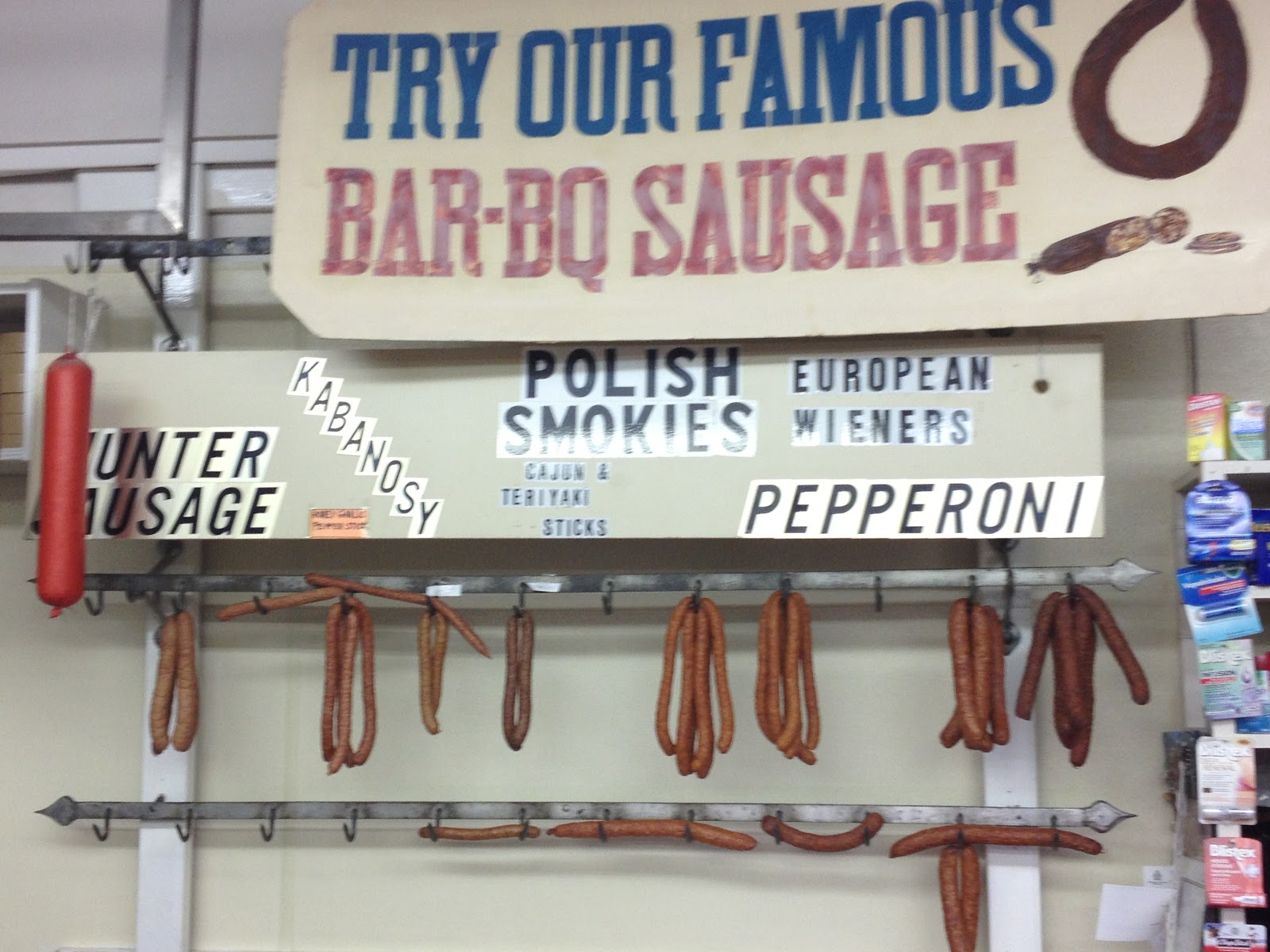
The Ringleaders of Kulbassa - Metro Meat

Located at 121 Euclid Avenue (204) 943-8217, Metro Meat boasts a fine selection of in-house cured meats. They are famous for their old world authentic Ukrainian kulbassa. Their sausage is smoked outdoors with oak, no temperature control or other new school tricks. People are passionate about their kulbassa and there are many sites that argue which is the best in town. I prefer the Metro Meat style, but variety is a wonderful thing.


One of the other great features of the store is the selection of mustards and horseradish to accompany your smoked meat.
They also have barbecue and sweet chili rings as well as a whole slew of other treats (see picture for the menu)
Metro Meat! The Ringleaders of Kulbassa!

Thursday, 1 November 2012

Cassoulet: A Midwinter’s Suppertime Dream


Every year, as the leaves desert the trees with the brisk approach of winter, my mind wanders back to the first time I tasted cassoulet. A rich, slow-cooked country casserole, cassoulet originated in the south of France. It’s name is derived from the word cassole, a deep round earthenware dish with slanted sides, in which it was traditionally prepared.
    
When I was twelve, my father took a sabbatical and moved us, for a year, to Great Milton, a small village in Oxfordshire England. I discovered many wonderful new things there: thatched roofs, shandy, that soccer is really football and American football is really rugby with helmets, pads and too many rules. I also discovered cassoulet.
   
In the middle of the chilly damp winter, our neighbours Richard and Elisabeth Balkwill invited us to share a meal that Richard had been preparing for two days. He was very proud, justifiably, of his recipe, which he had pried from the recipe book of an unwilling elderly gite owner his family had stayed with in Lapeze, a small town in the Dordogne region in the south of France.
    
To prepare cassoulet is simple, but requires patience. Here is what you need: about a pound of white navy beans, a pound of pork loin, a quarter pound of bacon, a dry European sausage (saucisson sec), six cloves of garlic, three large onions, the same amount of tomatoes, around a litre of chicken stock (decent store bought varieties are available, but homemade is much superior), a robust red wine (I suggest an Argentinian Malbec for quality and value) and finally bread crumbs.
    
The ingredients for the cassoulet Lapeze are easy to find at any local grocer, with the exception of the saucisson sec, or what Richard called a “dusty old French sausage”. For that you will need to find a meat shop dealing in European charcuterie, or perhaps an Italian specialty foods shop. An Italian calabrese with peppercorns will do the trick, as will any dried spicy sausage. You should consider getting your bacon there as well, as a properly smoked chunk of pork belly will make all the difference in your cassoulet, as compared with the water pumped, sulfite-rich varieties available at most grocery stores. Get it unsliced.
    
The morning of the day before you wish to serve your cassoulet, soak the beans for roughly eight hours in water. Go to work, go to a matinee, do what you do in the day. When you get home, in a large pot, cover the beans with water and simmer them gently, being sure to add a couple cubes of bacon. Now it’s prep time. Mince the garlic (saving a clove for later) and slice the onions and tomatoes roughly, no need for any fancy knife skills here. Cut the pork loin into one inch cubes and the sausage into quarter-inch thick slices. Next, dice the rest of the bacon, setting aside two slices to grease the pan for the pork loin. 
    
Cook the reserved bacon slices to release the fat and toss in the pork chunks, scattering some of the garlic overtop and cook them until slightly browned. Set them aside, leaving as much fat as possible still in the pan. Next, add the bacon and sliced onions, cooking them until the onions soften. Now add the remaining garlic and tomatoes to the pan and cook for five minutes. Add the wine and stock next and simmer for about twenty or so minutes. Your beans should be done right about now and will require draining.
    
Now is the time to get out your large crockery casserole (or closest facsimile of) and rub the inside with the remaining clove of garlic. Next, layer your ingredients in this order: browned pork, sausage, the “bacon stock” and finally the beans. The dish will cook in a 200 degree oven for twelve to fourteen hours, covered. It will reveal a layer of fat on top, to which you will add the bread crumbs and finish at 350 degrees until the top is brown and crispy. Let it set for ten minutes, then it’s time to eat! Cassoulet is very rich, so it pairs well with something light like a simple green salad.
    
Upon returning to Canada, Richard’s recipe in hand, my mother would try to re-create cassoulet Lapeze at least once every winter, a tradition I have upheld since leaving home. While our attempts are always delicious, Richard’s cassoulet has remained the finest I have ever tasted. Perhaps it was his Aga oven, an oil burning range they used, not only to cook, but to heat their home. The Aga includes a series of ovens and burners ranging in temperature. His cassoulet cooked slowly and gently overnight and through the next day in the oven with the lowest heat. Perhaps it is simply context, the newness of it touching my taste buds for the first time, it etched in my memory a potentially unsurmountable experience I will always pursue.